Breaking the Stigma: Bundutec at Red Clay Rally 2025
The 9th anniversary of the Red Clay Rally once again proved why it’s one of the toughest
events in the overland world. This year brought 21 teams, around 100 trucks, and 200
people into the Appalachian backwoods for 150 miles of trails covered over three days, in
just under 30 hours of driving. By the end, only 16 teams finished, a reminder that this rally
is built to test both trucks and people.
From the Start
The rally was never meant to be easy—or polished. It was designed to challenge the so-
called mall crawlers, drive-through warriors, and pavement princesses—the trucks built for
grocery runs and pavement posing—into actually being used for what they were built to do.
This rally doesn’t care how many light bars you bolted on, how shiny your recovery boards
look on Instagram, or whether your rig has ever even seen mud. Out here, the trails do the
judging. A TSD (Time–Speed–Distance) rally, it pushes rigs and drivers to adapt and endure,
proving they belong in the dirt, not just under fluorescent lights.
The Work Before the Work
For the mapping crew, it’s a 3–4 day push spent scouting routes in the Appalachian
backcountry, keeping the rally fresh and off pavement year after year. For competitors, it’s a
three-day test of endurance and skill. And for the logistics team, it’s an eight-day effort—
arriving the Monday before to set up basecamp, prep checkpoints, and lay the groundwork
so everything runs smoothly when teams line up Friday morning.
Bundutec as the Backbone
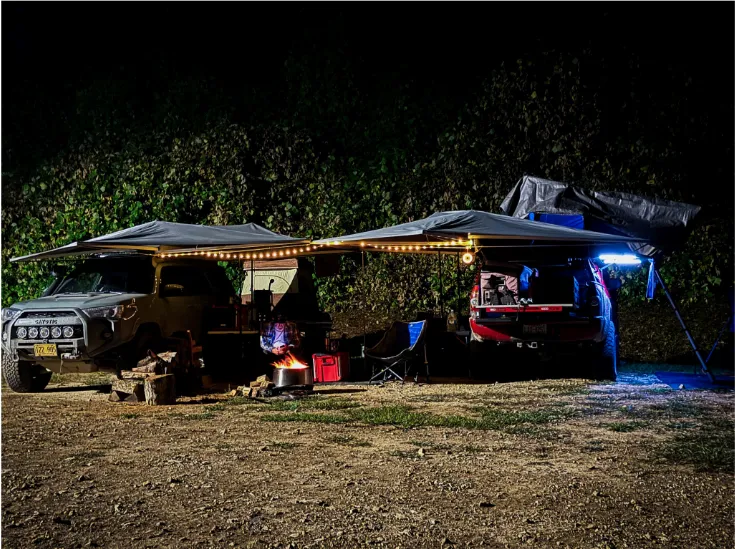
That’s where Bundutec came in. Both BunduAwns were deployed at basecamp, giving the
logistics crew dependable coverage through Appalachian storms and a dry, organized hub
for the crew.

Night at basecamp—two BunduAwns lit up and holding strong while plans came together. - Joe Rollar
On day three, one even went up to “Top of the World” for a checkpoint breakfast tradition—
providing shade and comfort at one of Kentucky’s best views.

Day three checkpoint breakfast at “Top of the World”—Bundutec shade at one of Kentucky’s best views. - Austin Stuart · Ollie Studios
And while Bundutec gear is often seen in adventure or leisure settings, here it was tested
against tight Appalachian trails, constant off-roading, and trees brushing against the awning
bags during scouting runs.

These weren’t parked-up rigs; the awnings stayed bolted on through every bump, scrape, and tight trail we scouted. - Joe Rollar
Through all of it, the BunduAwns performed flawlessly—proving they can handle the grind
of rally support just as well as a weekend at camp.
Walking through camp, you could see every kind of setup: tarps tied to trucks, sagging
canopies, DIY shelters. Among that sea of improvised solutions, we had not one but two
rock-solid, fast-deploy awnings that set us apart and kept the team covered when it
mattered most.
Why It Matters
The Red Clay Rally is as much about community as it is about the trails. For the logistics
crew, it’s eight days of laying the groundwork so checkpoint volunteers can do their jobs
when the rally begins. And through it all, Bundutec gave us a place to regroup, plan, and
even share a few fireside moments with checkpointers along the way.

The day before Top of the World breakfast: stormy, muddy conditions that tested both trucks and people. - Jacob Shuck
It wasn’t just gear—it was the difference between chaos and control. And in a rally built to
expose pretenders, Bundutec proved it was the real deal.
